

Quickstart for Developers
A high-performance multichain blockchain infrastructure built on a Hypernode cluster and a sophisticated data indexing engine, Nodit lets you start building across 81+ blockchain networks the moment an API Key is issued.
The Hypernode-based multi-node cluster delivers smart load balancing that accounts for sync state, along with automatic failover. Access high-performance node infrastructure through a single endpoint.
A sophisticated indexing engine structures on-chain data so that a single REST API call retrieves token balances, transfer history, NFT metadata, and more — no complex query logic required.
Start on the free plan and pay only for what you use with Compute Unit (CU)-based metered billing. Scale your plan up or down as your project grows.
Enterprise-grade availability and security infrastructure apply equally to personal projects and production services. Auto-scaling maintains service continuity even as traffic increases.
0. Prerequisites
Sign up and create a project in the Nodit Console. (Your first project is created automatically upon registration.) API Keys are issued per project, so at least one project is required to make API calls.
1. Check Your API Key
Every Nodit API request requires an API Key issued for the project. Select a project in the Nodit Console and find the key on the Dashboard tab.
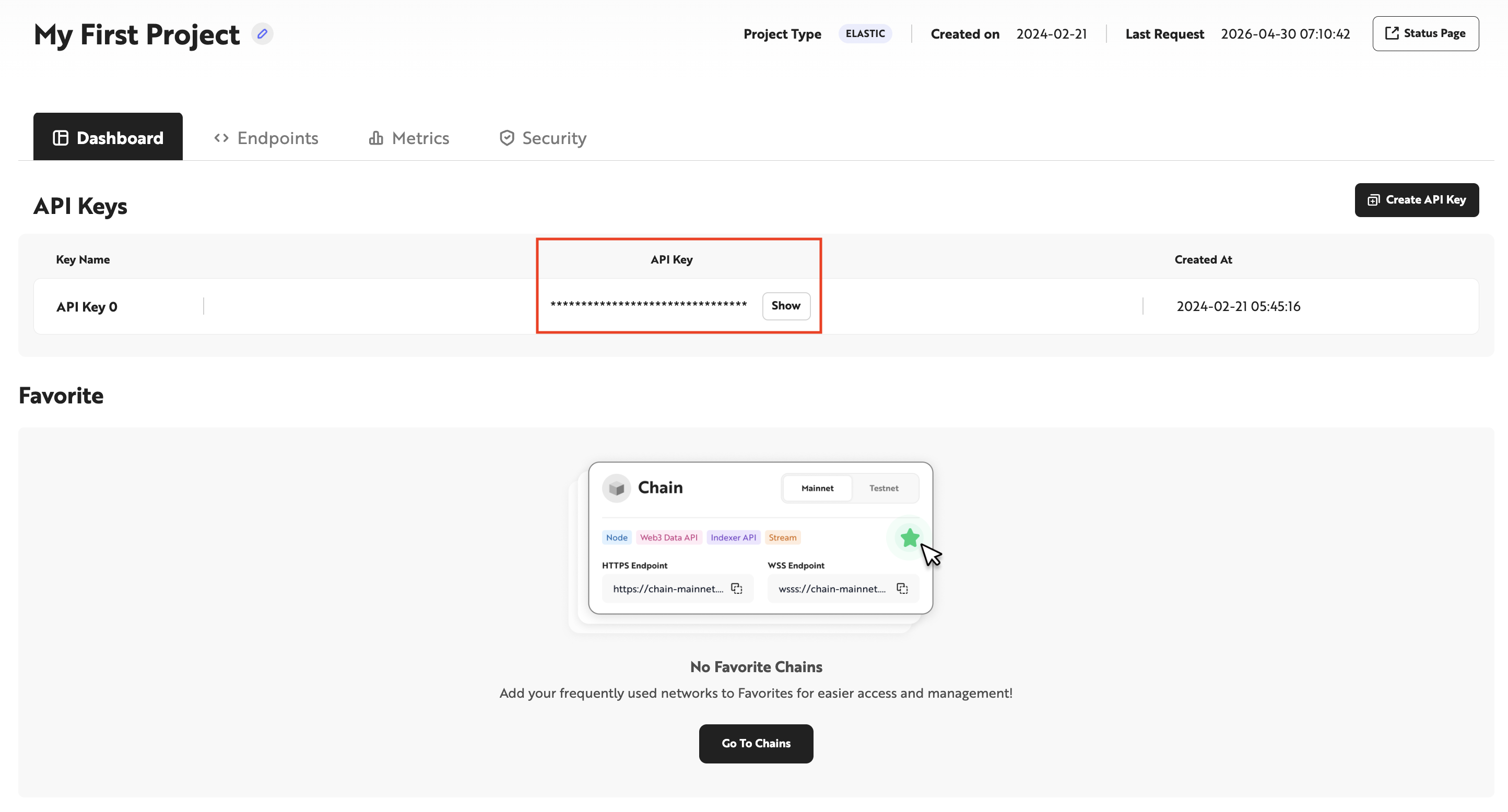
Copy your API Key from the Nodit Console and paste it into the input field below. The key is automatically applied to the interactive call examples further down this page.
Your API Key will be applied to the code examples and requests below.
With your API Key confirmed, check which APIs are available for the chain you plan to use. This makes it straightforward to map the examples below to your actual project.
2. Check Chain Coverage
Supported APIs and services vary by chain, and the full coverage is visible in both the console and the documentation. Some chains support both RPC API and Data API; others support only one. Depending on the scope, you may also need to review the Webhook, Stream, or Indexer API documentation.
In the console, go to the Chains screen, select a chain, and open Copy Endpoint. This shows all API types available for the selected project and network at a glance.
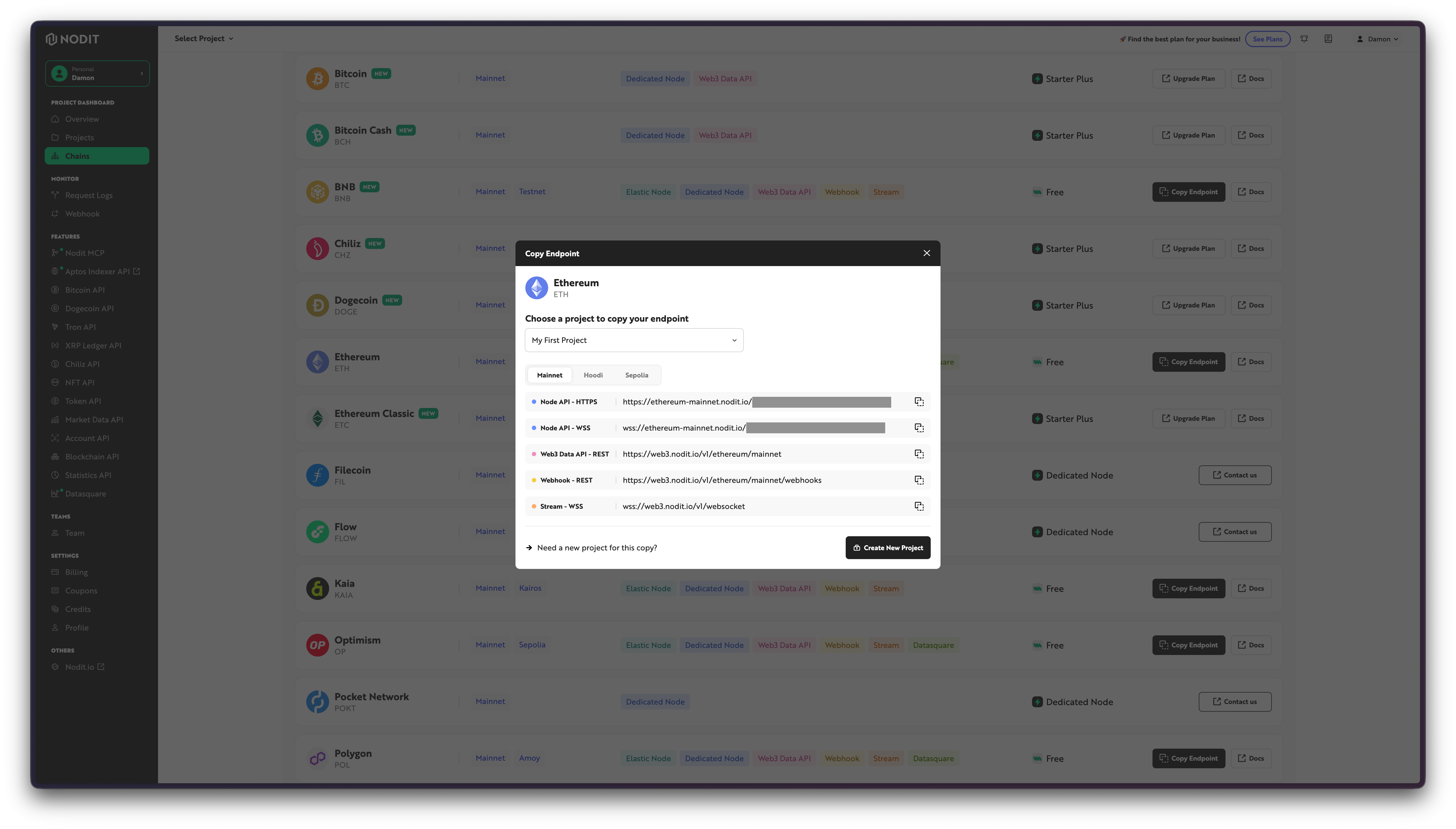
The popup displays endpoints for each API type supported by the selected chain. For example, RPC API provides HTTPS and WSS addresses, while Data API provides a REST endpoint. Depending on chain support, Webhook, Stream, and Indexer API addresses may also appear.
The examples in this document are fixed to Ethereum Mainnet and cover RPC API and Data API as representative cases.
With coverage confirmed, call the APIs directly within this page to see response formats and usage patterns. Start with RPC API, which returns raw RPC responses, then move on to Data API, which returns structured data.
3. Try API Calls
Working through these two examples in order gives you a quick comparison of the different data access approaches Nodit provides.
3-1. Call the RPC API
This example connects to the Ethereum Mainnet RPC API and queries a native asset balance using the eth_getBalance method. The Ethereum RPC API operates over JSON-RPC, and each method requires specific params. This method takes an account address and the block reference value latest.
Enter the API Key above and click Try it out to see the response.
curl -X POST 'https://ethereum-mainnet.nodit.io/' \
  -H 'Content-Type: application/json' \
  -H 'X-API-KEY: nodit-demo' \
  -d '{
    "id": 1,
    "jsonrpc": "2.0",
    "method": "eth_getBalance",
    "params": ["0xd8dA6BF26964aF9D7eEd9e03E53415D37aA96045", "latest"]
}'A successful request returns the balance as a hexadecimal string in wei. Applications can convert this value to ETH units for display in wallet balance or portfolio screens.
With the basic RPC call pattern confirmed via RPC API, the next step shows how to retrieve the same account data in a more structured form using Data API.
3-2. Call the Data API
The getTokensOwnedByAccount method queries the USDC and USDT token balances held by a specific account on Ethereum Mainnet. This example passes both stablecoin contract addresses in the contractAddresses parameter to retrieve only the target assets. Data API uses REST, and unlike RPC API — where you assemble raw responses yourself — it returns indexed data in a structured format, making it well-suited for building asset screens or backend query features.
Enter the API Key above and click Try it out to see the response.
curl -X POST 'https://web3.nodit.io/v1/ethereum/mainnet/token/getTokensOwnedByAccount' \
  -H 'Content-Type: application/json' \
  -H 'Accept: application/json' \
  -H 'X-API-KEY: nodit-demo' \
  -d '{
    "accountAddress": "0xd8dA6BF26964aF9D7eEd9e03E53415D37aA96045",
    "contractAddresses": ["0xA0b86991c6218b36c1d19D4a2e9Eb0cE3606eB48", "0xdAC17F958D2ee523a2206206994597C13D831ec7"],
    "page": 1,
    "rpp": 10
}'Once both example calls are working, the patterns shown here can be carried over into your actual project setup. The next section covers how to connect using your own chain, your own endpoint, and your preferred development tools.
4. Apply It to Your Project
This document demonstrated a few API calls against Ethereum Mainnet. When integrating with a real application, first verify the supported scope for the target chain and network — as covered in step 2 — then apply the endpoint and request format for your project.
- On the Chains screen in the console, select the chain and network you want to use.
- In the Copy Endpoint popup, find the endpoint to connect to your project.
- From the supported API types, select the endpoint you need.
- In each API's documentation, review the request format and parameters for each method and apply them to your application.
4-1. Connect a Node Endpoint
On EVM chains such as Ethereum, you can connect directly to local development tools like Hardhat and Foundry. Manage the API Key as an environment variable when applying to a real project.
Add the Nodit endpoint to the networks configuration in hardhat.config.ts or hardhat.config.js.
import { HardhatUserConfig } from "hardhat/config";
import "@nomicfoundation/hardhat-toolbox";

const config: HardhatUserConfig = {
  solidity: "0.8.28",
  networks: {
    noditEthereum: {
      url: `https://ethereum-mainnet.nodit.io/${process.env.NODIT_API_KEY}`,
    },
  },
};

export default config;
Set the environment variable, then run the following command.
NODIT_API_KEY={YOUR_API_KEY} npx hardhat console --network noditEthereumWith the Node connection in place, results from both RPC API and Data API for the same account can be combined to build user-facing screens or backend responses.
4-2. Portfolio Example
Combining the balance query API shown earlier with getTokensOwnedByAccount produces an account asset view like the one below. This inline example uses the API Key entered above to display ETH holdings and USDC/USDT stablecoin balances for a specific address on Ethereum Mainnet in a single view.
Portfolio Preview
ETH + Stablecoin Balances
Click the button to load the ETH balance.
Click the button to load stablecoin balances.
Next Steps
After reviewing the portfolio example, continue with the documentation relevant to your project.
- API Overview — Full list of supported API types and endpoints by chain
- Data API — Query API backed by on-chain data indexing
- Webhook — Send notifications to a designated server when on-chain events occur
- Stream — Subscribe to on-chain events in real time over a persistent WebSocket channel
- Faucets — Claim testnet tokens