

Elastic Node
Key Features
Nodit's dedicated operations team manages shared node infrastructure with 99.9% SLA. Access a reliable blockchain RPC API environment immediately, without building or staffing your own infrastructure.
Access over 21 EVM-compatible networks through a single Endpoint pattern. Chain-specific client differences are abstracted away, providing a consistent integration approach.
Resources adjust automatically in response to workload changes, ensuring uninterrupted operation. Additional costs apply only for excess usage, keeping expenses predictable. (Paid Plan)
Start calling RPC APIs immediately after issuing an API Key — no infrastructure setup required. Full RPC API coverage includes smart contract deployment and transaction submission.
Overview
Elastic Node is a scalable shared node solution that reduces operational overhead by leveraging managed shared infrastructure instead of running blockchain nodes directly. Through shared node Endpoints operated by Nodit's dedicated team, call blockchain RPC APIs immediately — without building separate infrastructure — to query network state and submit transactions. For smart contract deployment, connect the assigned Endpoint to your development environment and deploy to the network of your choice.
Nodit's entire node infrastructure is shared across all projects. The resources allocated to each project are elastically adjusted within the maximum performance of its plan, based on real-time usage and usage patterns. With 99.9% SLA, a dedicated operations team, and support for over 70 chains, Elastic Node offers a cost-effective alternative to self-managed infrastructure from a Total Cost of Ownership (TCO) perspective. If your workload is variable or may exceed the maximum usage of your selected plan, enable the Auto Scaling option to continue operating without interruption — paying only for the excess usage.
For enterprises that need to launch blockchain services quickly, Elastic Node shortens the infrastructure preparation period so teams can focus on core service development.
For the list and specifications of RPC APIs available through Elastic Node Endpoints, refer to the chain-specific RPC API pages in the API Reference menu. Nodit's plan usage allowance is shared across all features, including RPC API, Data API, and Webhook/Stream. For per-API usage deductions and details, see the Usage Measuring(CU) page.
Use Cases
DeFi Integration for Financial Institutions
Financial institutions that require real-time on-chain data retrieval can establish a stable blockchain data access layer through Elastic Node Endpoints. By leveraging managed infrastructure with 99.9% SLA, integrate DeFi protocol connectivity, balance queries, and transaction status checks into your services. Using professionally managed infrastructure instead of self-operated nodes reduces operational risk and frees resources for regulatory compliance.
Multichain Portfolio Services
Portfolio services that need to query assets across multiple blockchain networks can reduce implementation complexity through Elastic Node's single Endpoint pattern. Over 21 EVM-compatible networks are accessible through a uniform calling convention, eliminating the need to manage separate clients per chain. When adding new chains, extend the existing integration structure by changing only the Endpoint.
Enterprise Backend Integration
When adding a blockchain data layer to an existing backend system, Elastic Node supports integration through a standard JSON-RPC interface. Start integrating immediately after issuing an API Key — no infrastructure setup required — shortening project timelines. The Auto Scaling option ensures uninterrupted operation even during traffic spikes.
HyperNode Technical Architecture
The primary technical challenge of pool-based node infrastructure is making a node pool composed of multiple physical nodes behave logically as a single blockchain node. Because each blockchain node maintains its own block synchronization state and transaction pool (mempool), simply adding physical nodes and distributing traffic cannot guarantee consistent behavior. As the node handling a request changes, different latest block data may be returned, or follow-up queries on submitted transactions may fail to retrieve correct information.
Nodit's HyperNode is a node abstraction layer designed to resolve state inconsistency between nodes during infrastructure scaling and to guarantee data consistency. HyperNode monitors the state of all nodes at the front of the node pool to build a shared state pool, then delivers optimized responses based on request context — providing high data consistency and real-time performance, fast response times, and scalability.
Data Consistency and Real-Time Performance
HyperNode load-balances requests based on a shared state view, routing each RPC API request to the most suitable node. This ensures real-time access to the latest block information in the node pool, without data inconsistencies caused by differing block states across nodes.
Scalability
HyperNode supports flexible scaling of the shared resources that compose Elastic Node. Its data abstraction, context-based load balancing, and transaction management capabilities minimize the complexity introduced by physical resource expansion, enabling linear resource scaling.
HyperNode is applied across all networks that compose Elastic Node.
Key Functions
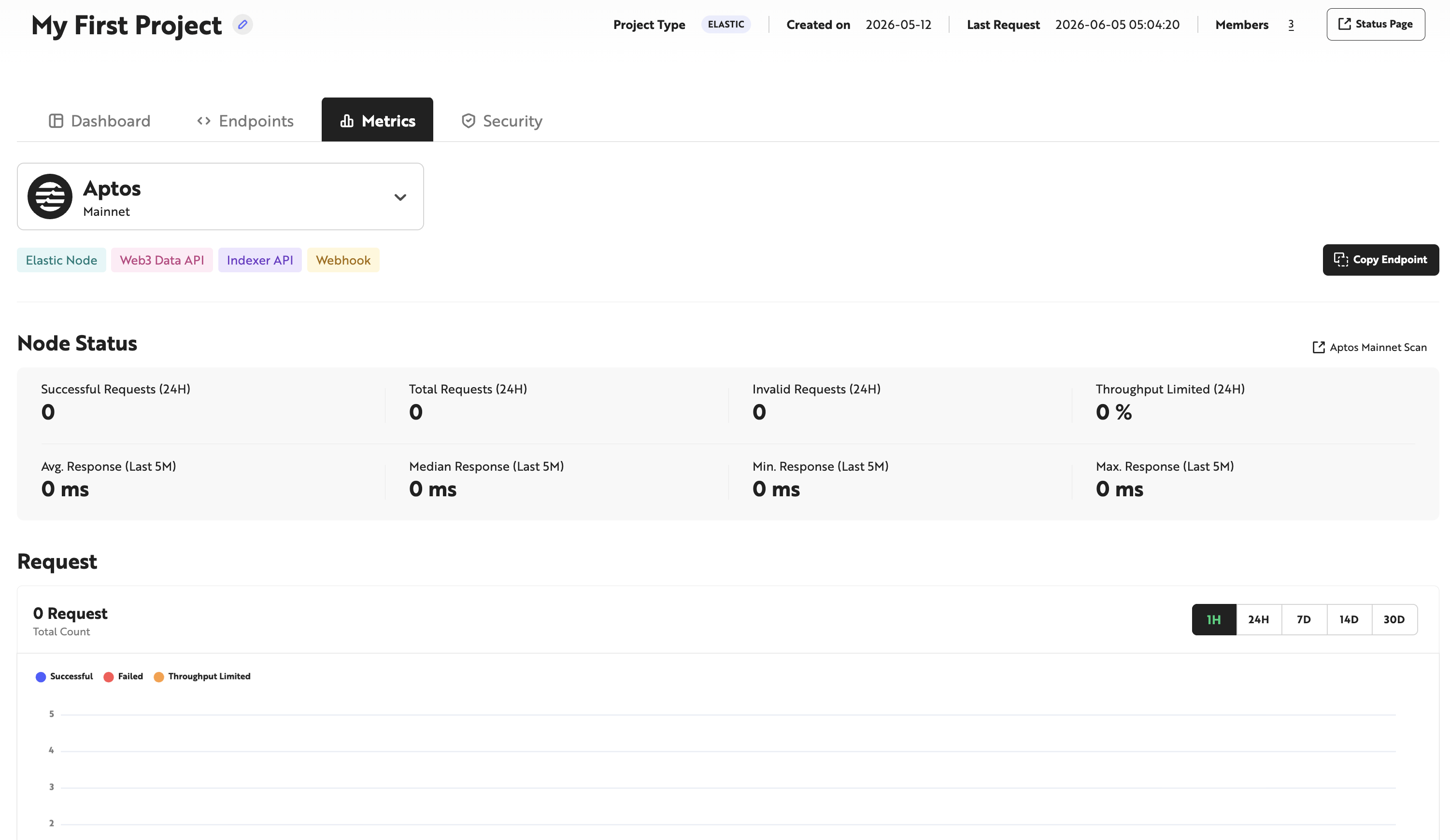
Monitor response time trends and error rates for each chain in a single view during service operations, enabling incident response and SLA monitoring. Navigate to the per-network Dashboard by clicking a chain name or card area in the Network list or Favorites list.
- HTTPS / WSS Endpoint addresses
- Successful, total, and invalid request counts (24H)
- Throughput Limited request count (24H)
- RPC API response time statistics (average, median, min, max — last 5 minutes)
- Total request count and Throughput Limited graphs by period
Track RPC API call history to detect anomalous requests and verify integration tests. View and trace all RPC API call records made to the node. For details, see the Request Logs page.
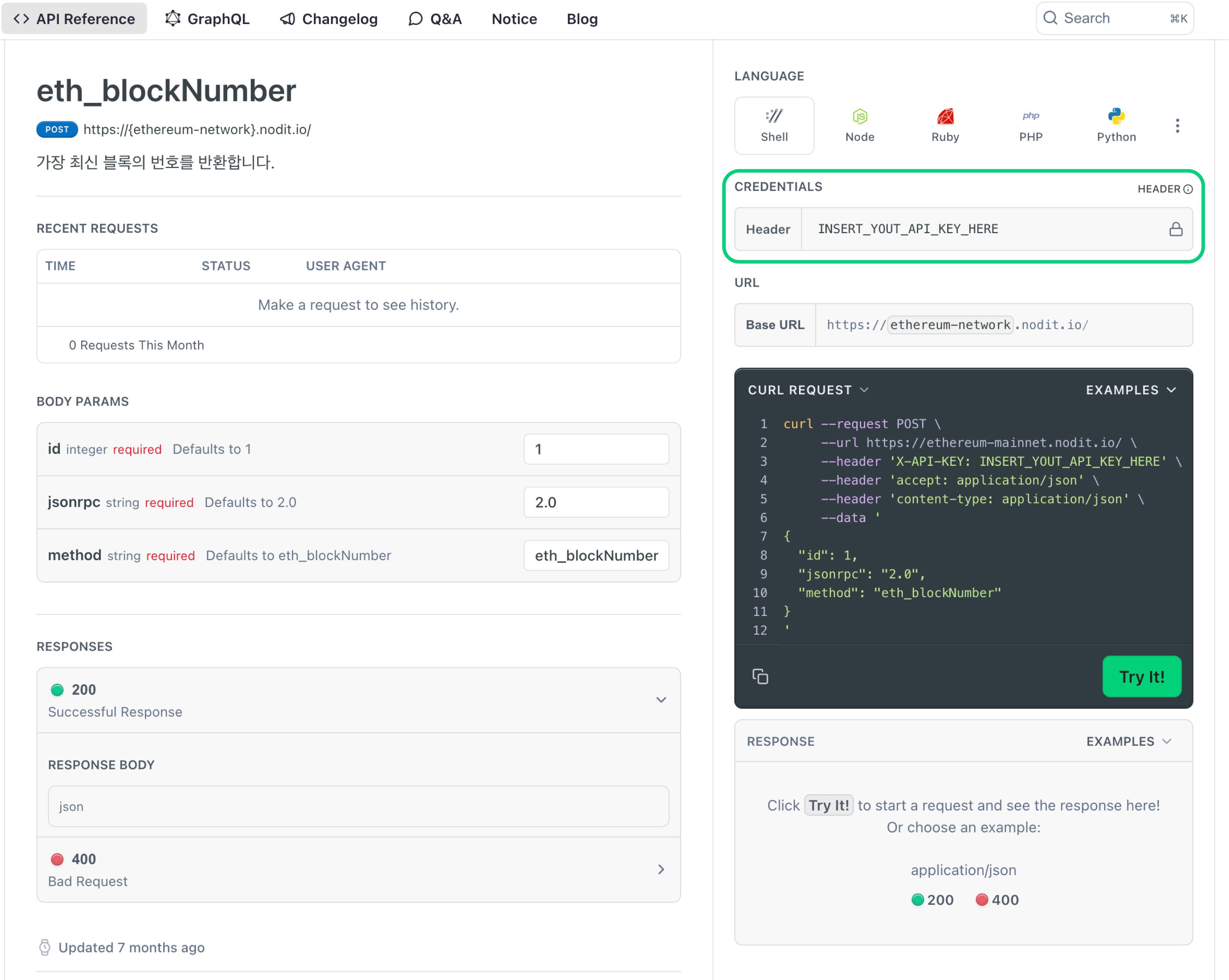
Test API calls with the parameters of your choice and inspect responses directly from the API Reference page — no separate development environment required. On the RPC API page you want to test, enter your issued API Key in the CREDENTIALS area, then execute the API example.
Getting Started
Follow the steps below to connect an Elastic Node Endpoint to your project. Start with the Free Trial plan to access an immediately available Elastic Node Endpoint. Follow the guide on the Get Started with Nodit page to navigate to the project Overview screen in the Nodit Console.
Check the Full List of Available Elastic Node Networks
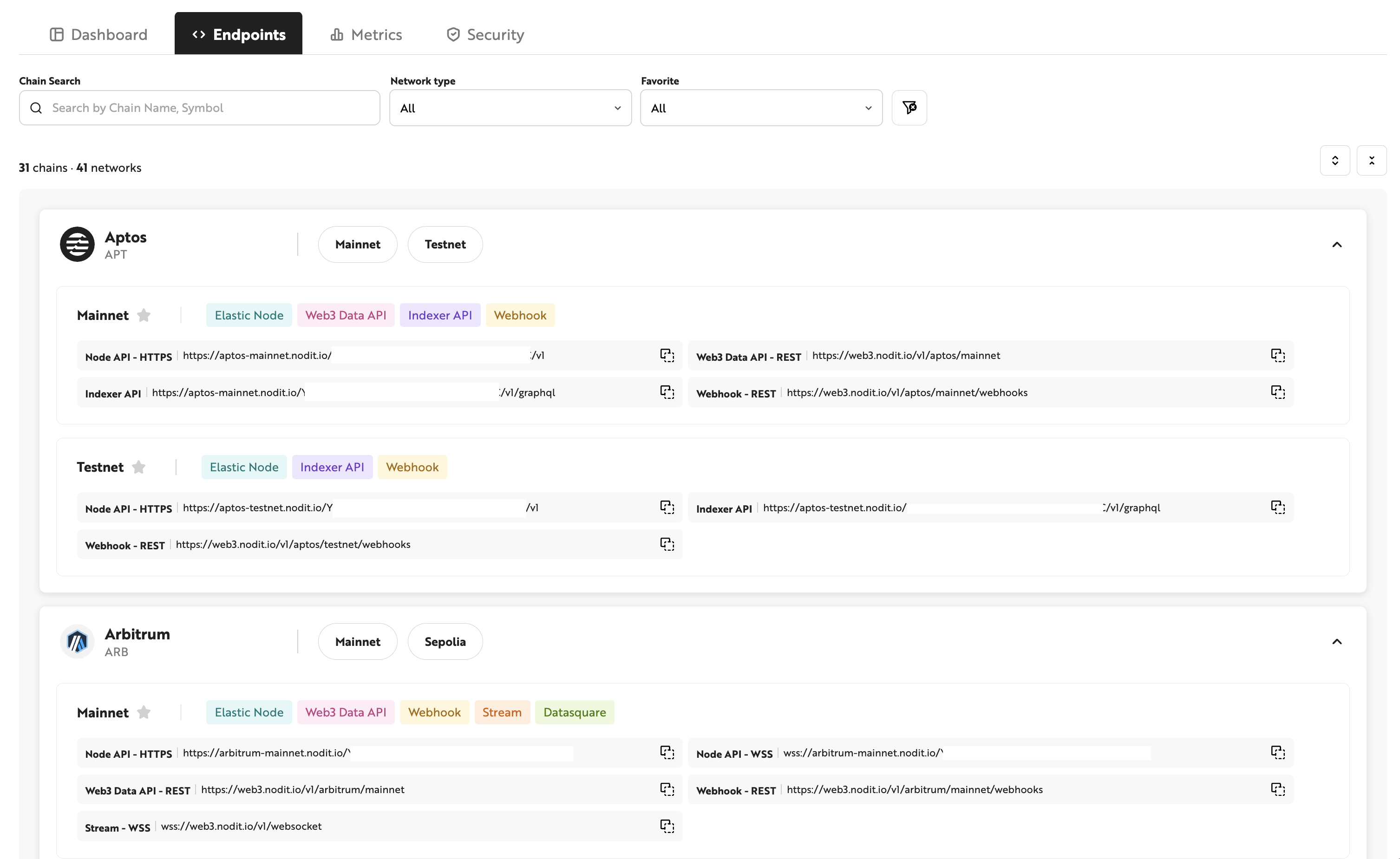
Click the Endpoints tab on the project detail screen to view the full list of available networks. Available features for each network are displayed as tags. From the HTTPS Endpoint, WSS Endpoint, and Indexer API Endpoint areas, you can view and copy Endpoint addresses for RPC API, Stream, and other development tool integrations.
Add Networks to Project Favorites
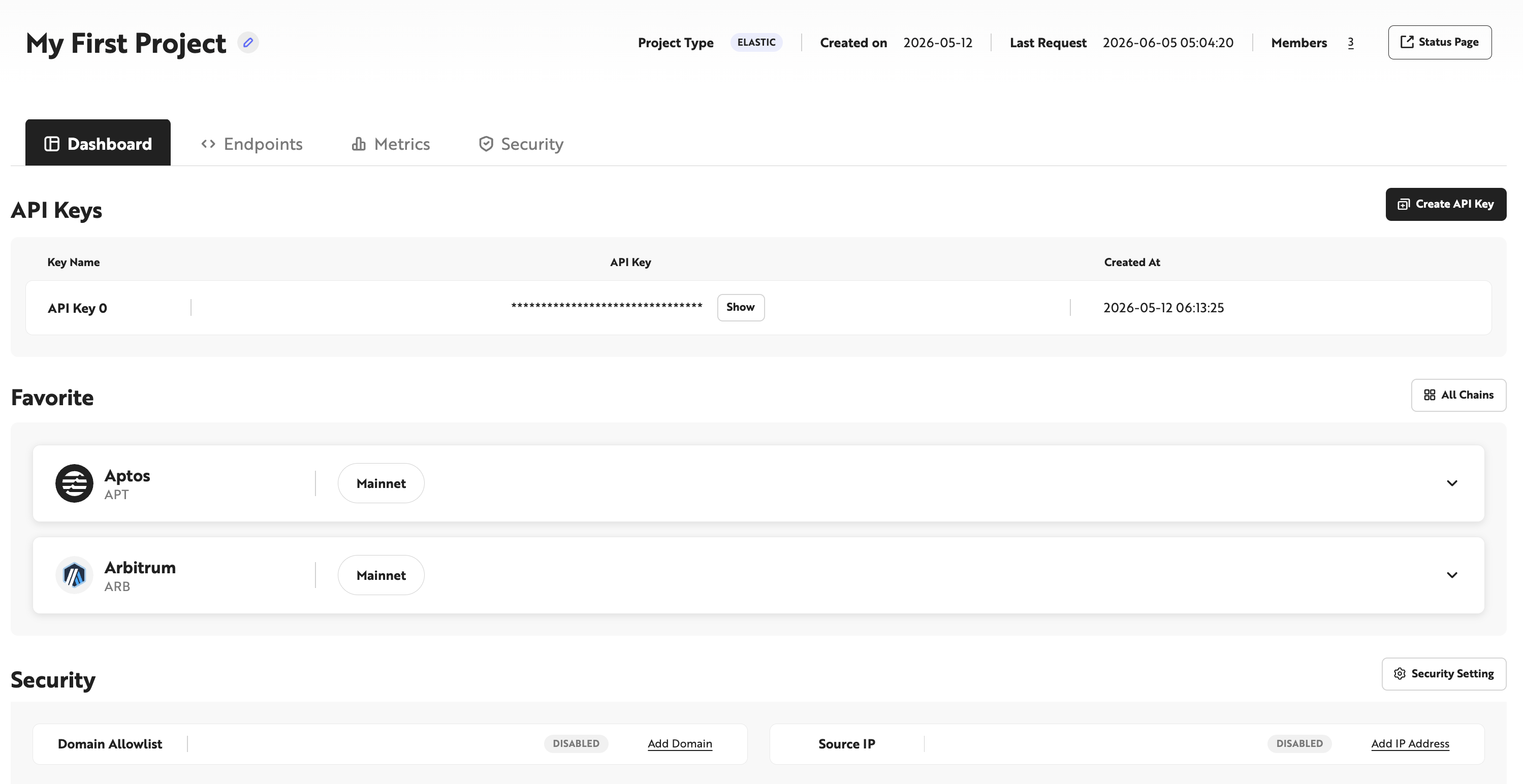
Click the star icon inside each network card to add or remove a network from your favorites. Favorited networks appear in the Favorite Networks area on the project Dashboard for quick access.
Call RPC APIs
After connecting the desired node to your project, verify the HTTPS Endpoint or API Key and start calling RPC APIs. For chain-specific RPC API lists and specifications, see the API Reference page.